Testing Different Pose-Ranking Methods for RBFE Calculations
by Zachary Fried · Aug 6, 2026
Structure-based drug discovery is a powerful paradigm in computer-assisted drug design. Where sufficient structural information exists, leveraging this information to run complex protein–ligand simulations and predict the impact of various modifications can be incredibly enabling and lead to otherwise hard-to-anticipate discoveries. Unfortunately, the requirement for accurate structural information is also a substantial limitation. Where experimental crystallographic data is scarce, it's easy to accidentally simulate the wrong conformer or pose and generate completely irrelevant data.
This issue is particularly acute for free-energy perturbation (FEP), which requires scientists to choose reasonable poses for as-of-yet unsynthesized compounds where no experimental data exists. While poses for most compounds can be generated approximately by aligning them to a known reference compound, getting the exact torsional preferences of new functional groups right is a tough process that is still largely done manually in industry, dramatically limiting the throughput of FEP.
A few months ago, we wrote about updates to Rowan's analogue-docking workflow that substantially improved pose generation for various ligand series. Analogue docking uses a known template pose to generate well-aligned poses for a set of analogues. As discussed above, this is particularly useful for downstream relative-binding-free-energy (RBFE) calculations, where starting from ligands with well-aligned geometry is known to improve convergence, runtime, and accuracy.
Across the JACS RBFE benchmark systems (Wang et al. 2015), we showed that our analogue-docking workflow could typically generate poses very close to the reference poses reported in the benchmark set. But finding a good pose somewhere among up to 20 candidates is only part of the problem: if we want to run end-to-end FEP without human pose inspection, we also need to reliably rank that pose at the top so we know which structure to send to our RBFE workflow.
In this post, we ask two questions: (1) How well does our current scoring procedure rank the best poses? And (2) how much does picking a "good enough" pose that's not quite the best matter downstream?
How well do we rank the best pose?
Analogue docking can return several candidate poses for each ligand (up to 20 per analogue by default in our workflow). When carrying these structures forward into RBFE, we typically select the top-ranked pose. In this retrospective benchmark, we can compare every generated pose to the JACS reference and identify the one with the lowest heavy-atom RMSD. However, in a normal calculation, we do not have that reference, so we instead have to rely on the scoring function to place a useful pose at the top.
To test our pose-selection methods, we used the same eight protein targets from the JACS RBFE test systems that we used in our earlier analogue-docking work. Across these systems, we had about 190 analogues with reference poses reported in the JACS benchmark set. For each ligand, analogue docking generated between 1 and 20 candidate poses.
We ran the workflow in two ways. First, we evaluated the poses directly as they were produced by analogue docking, without any further MM/GBSA optimization (this is Rowan's current default workflow). Separately, we ran analogue docking with an additional MM/GBSA optimization step and evaluated this optimized set of poses on its own.
With the reference pose for each ligand, we then calculated the heavy-atom RMSD of every generated pose to the corresponding JACS reference pose and identified the closest pose available in each conformer ensemble. This assumes that the JACS reference pose is correct, which isn't always necessarily true, since these poses were selected by human experts rather than by experimental crystallography—but poses far from the reference are almost certainly wrong.
With this information, we asked the question: how often does each scoring method rank that exact lowest-RMSD pose first?
We compared Rowan's default Vina scores with several fast reranking alternatives, including single-point MM/GBSA, GNINA's CNN scores, ligand single-point energies (using AIMNet2, g-xTB, and GFN2-xTB), strain-based scores (with xTB and AIMNet2), and AEV-PLIG. Note that single-point MM/GBSA scoring was only run on the MM/GBSA-optimized pose set. The plot below shows the fraction of analogues across all eight systems for which each scoring method ranked the lowest-RMSD pose first:
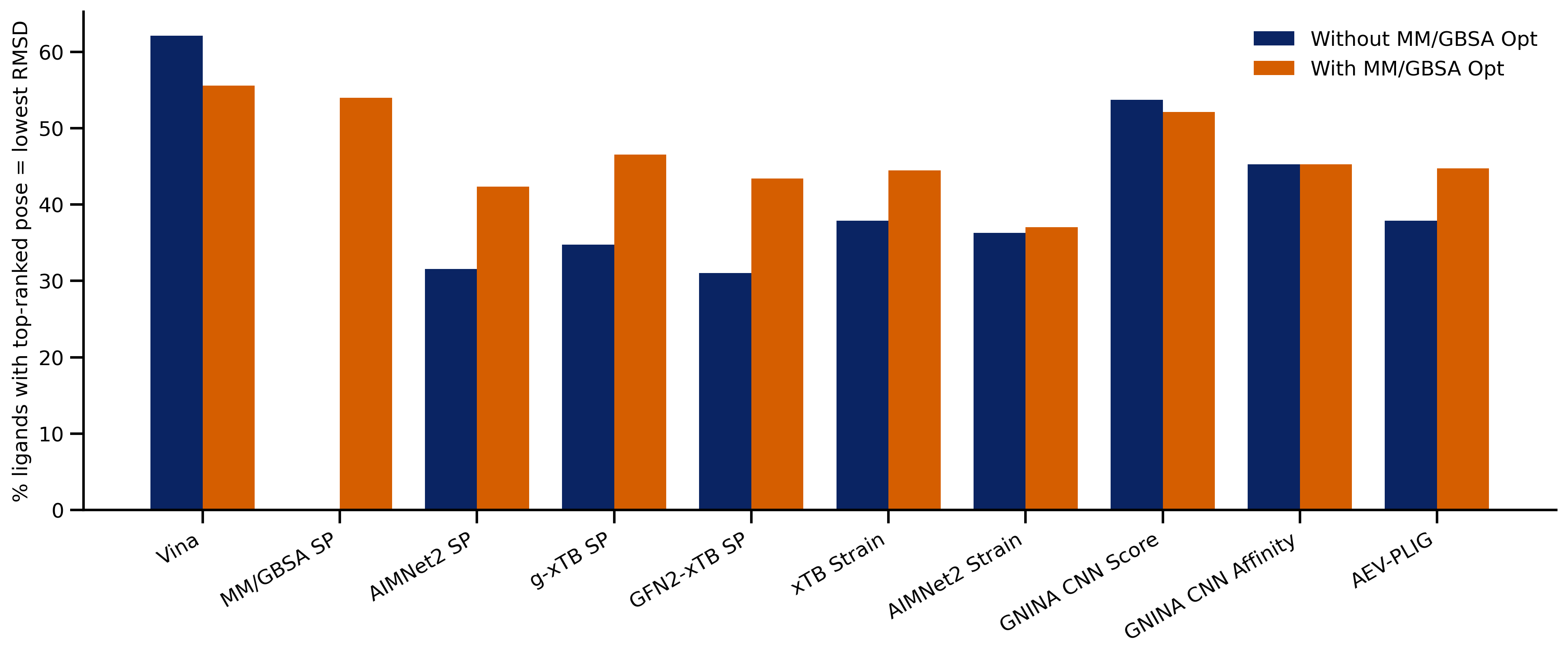
Figure 1. Percentage of analogues for which each reranking method selected the lowest-RMSD pose, with and without MM/GBSA optimization. Single-point MM/GBSA scoring was only run on the MM/GBSA-optimized pose set.
While it wasn't perfect, the default method turned out to be tough to beat. For poses produced by Rowan's standard workflow (without additional MM/GBSA optimization), Vina ranking using the Vinardo scoring function ranked the lowest RMSD pose first for about 62% of analogues.
More expensive protein-aware approaches did not improve on that result. For the separately generated MM/GBSA-optimized pose set, Vina ranked the lowest-RMSD pose first about 55% of the time, while ranking those same poses by MM/GBSA reached about 54%. GNINA also performed reasonably well, but did not consistently beat the standard Vina ranking.
The ligand-only single-point and strain-based methods generally performed worse across the full benchmark. That makes some sense: they can tell us whether the ligand geometry itself looks unfavorable, but they do not directly capture how well a pose interacts with the protein.
How bad is a ranking miss?
At first glance, a 62% hit rate did not sound especially encouraging. But this metric doesn't tell the whole story. Selecting a 0.55 Å RMSD pose when a 0.43 Å RMSD pose was available counts as the same miss as selecting a completely different 4 Å RMSD binding mode, although those are clearly very different outcomes.
So instead of only asking whether we picked the single best pose, we looked at the heavy-atom RMSD of the pose the workflow would actually return, and the results looked much better.
The box-and-whisker plots below show the heavy-atom RMSD distributions across all analogues in each system, comparing the best (lowest RMSD to reference structure) pose available in each ensemble with the pose ranked first by Vina and, for the optimized set, by MM/GBSA. MCL1 and PTP1B use an extended y-axis to include the small number of larger outliers.
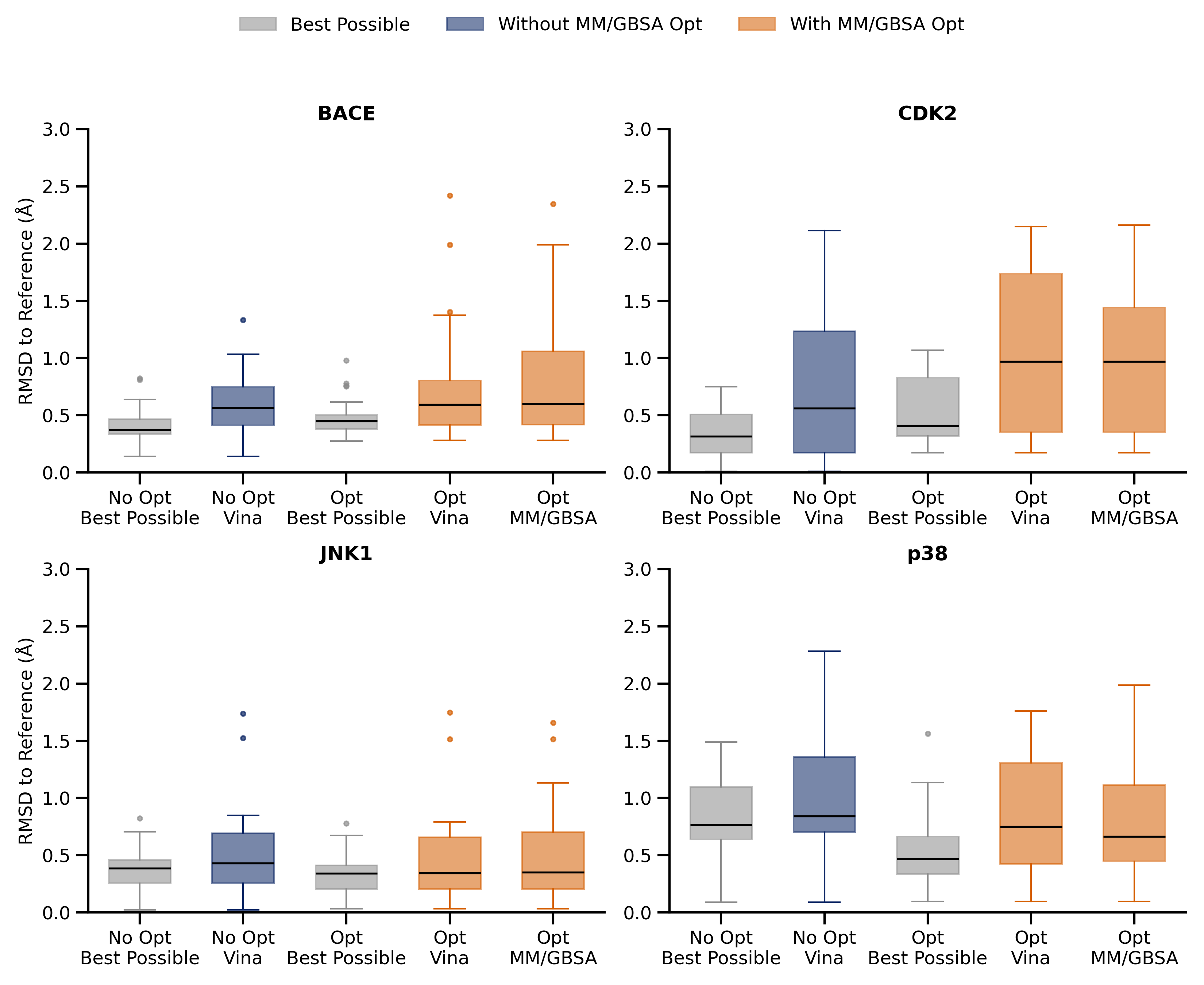
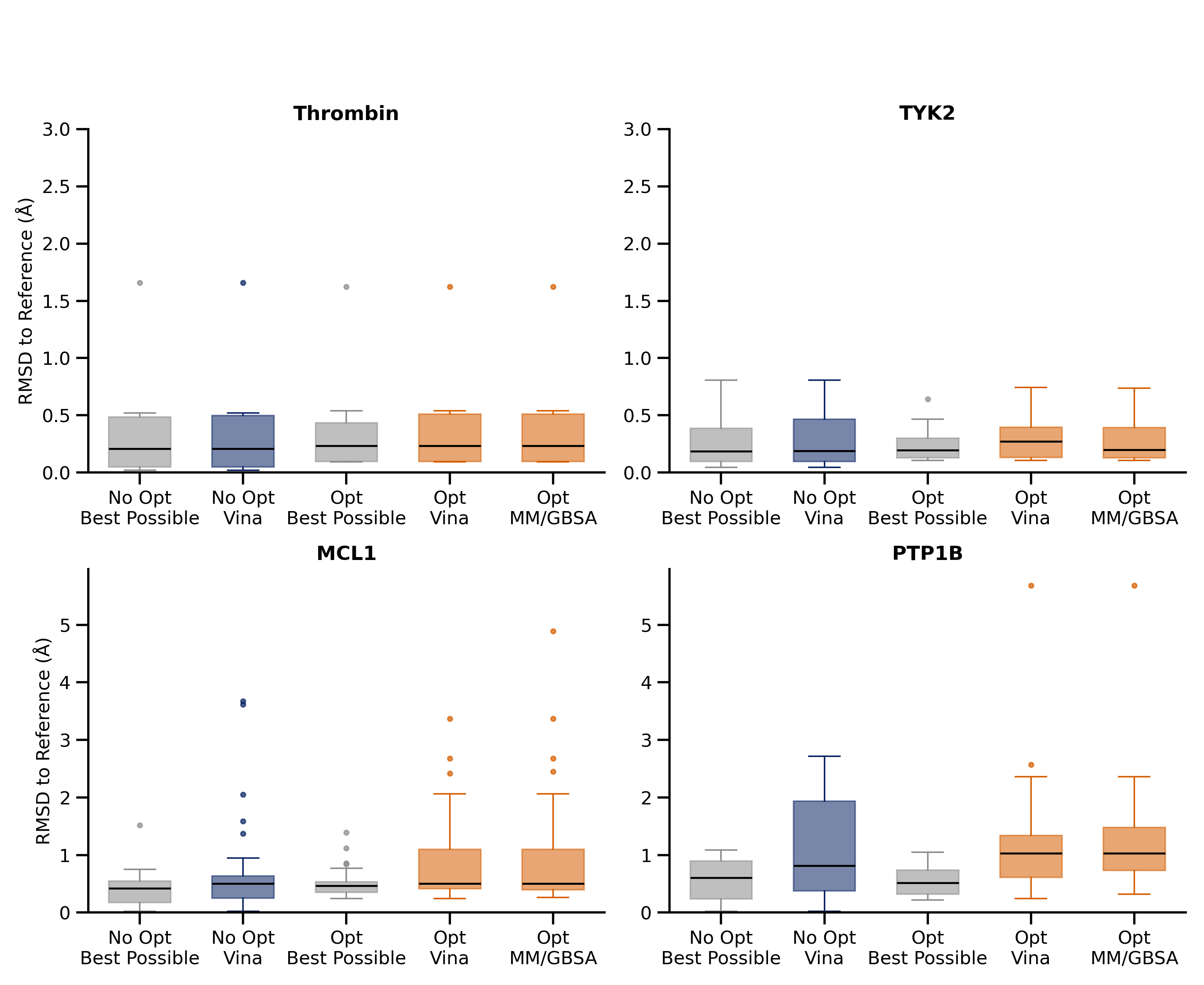
Figure 2. RMSD from the JACS reference structure for the best available and top-ranked poses across the eight JACS benchmark systems.
For the pose ranked #1 by Vina in the analogue-docking runs without additional MM/GBSA optimization, the median heavy-atom RMSD to the JACS reference pose was only 0.55 Å. Additionally, about 80% of these top-ranked poses were within 1 Å of the reference pose, and more than 94% were within 2 Å.
For context, the median heavy-atom RMSD drops only to 0.43 Å if we always choose the closest pose available in each generated ensemble. Therefore, most ranking "failures" are not cases where the workflow chooses a drastically different pose. More often, several poses are already close to the JACS reference pose and the scoring function chooses a slightly "worse" member of that group due to a somewhat modified geometry of the flexible side-groups.
How much does MM/GBSA optimization change the poses?
We also wanted to understand how much the additional MM/GBSA optimization actually changes the structures produced by analogue docking. During this step, we do not constrain the ligand atoms to remain aligned with the original analogue-docking pose. The ligand is free to relax while the protein is restrained.
Surprisingly, optimization had very little effect on the overall pose alignment. Looking at the lowest-RMSD pose available for each analogue, the median heavy-atom RMSD to the JACS reference pose was 0.43 Å before optimization and 0.42 Å after optimization.
As one example, the images below show overlays of the best Vina-ranked pose for every BACE analogue before MM/GBSA optimization (first image) and after optimization (second image). Visually, the shared cores become somewhat less tightly aligned after optimization. Even so, the median heavy-atom RMSD increases only modestly from 0.57 Å to 0.59 Å, although the optimized poses show a somewhat broader spread.
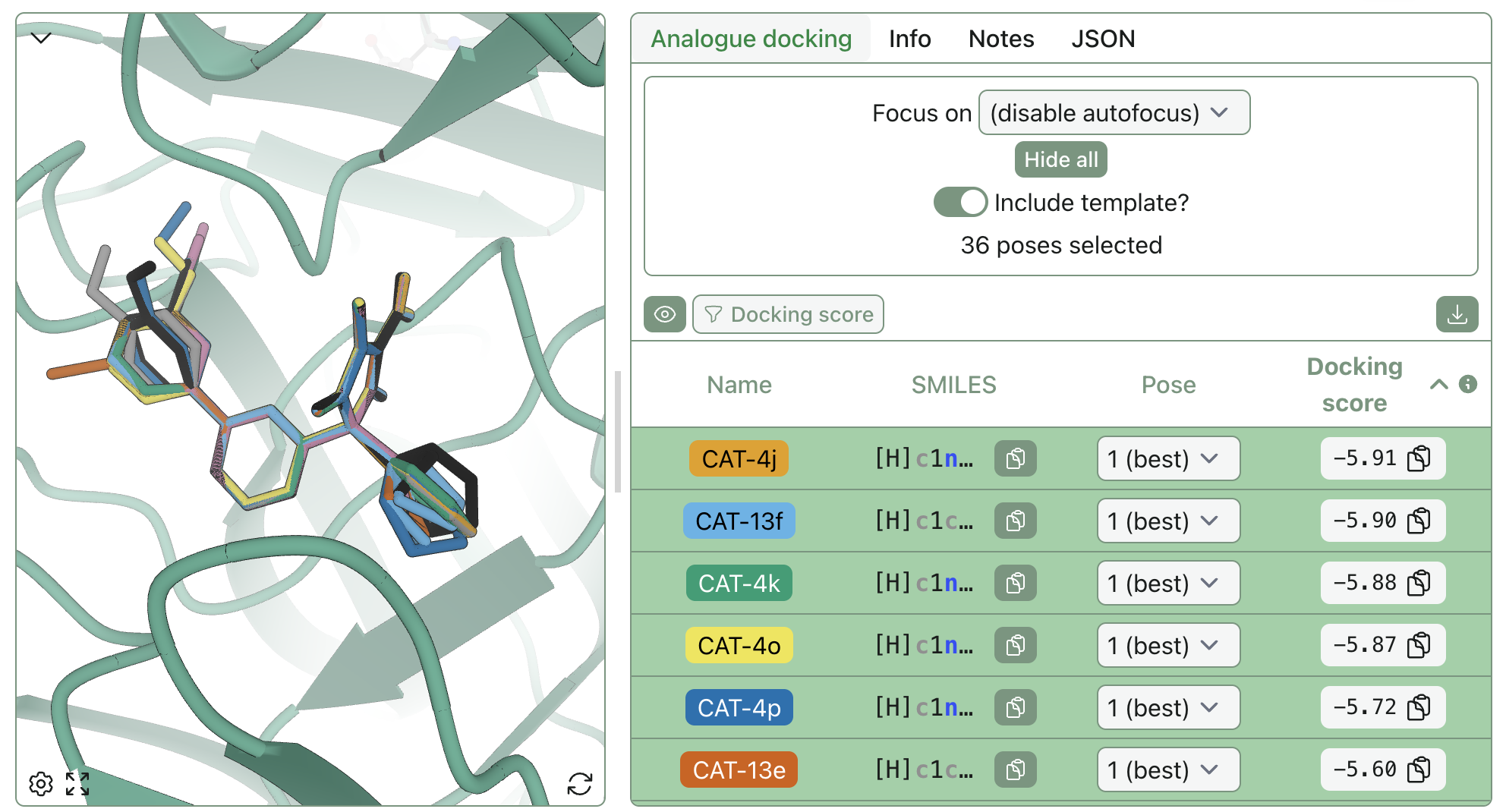
Figure 3. Overlay of the best Vina-ranked pose for each BACE analogue before MM/GBSA optimization.
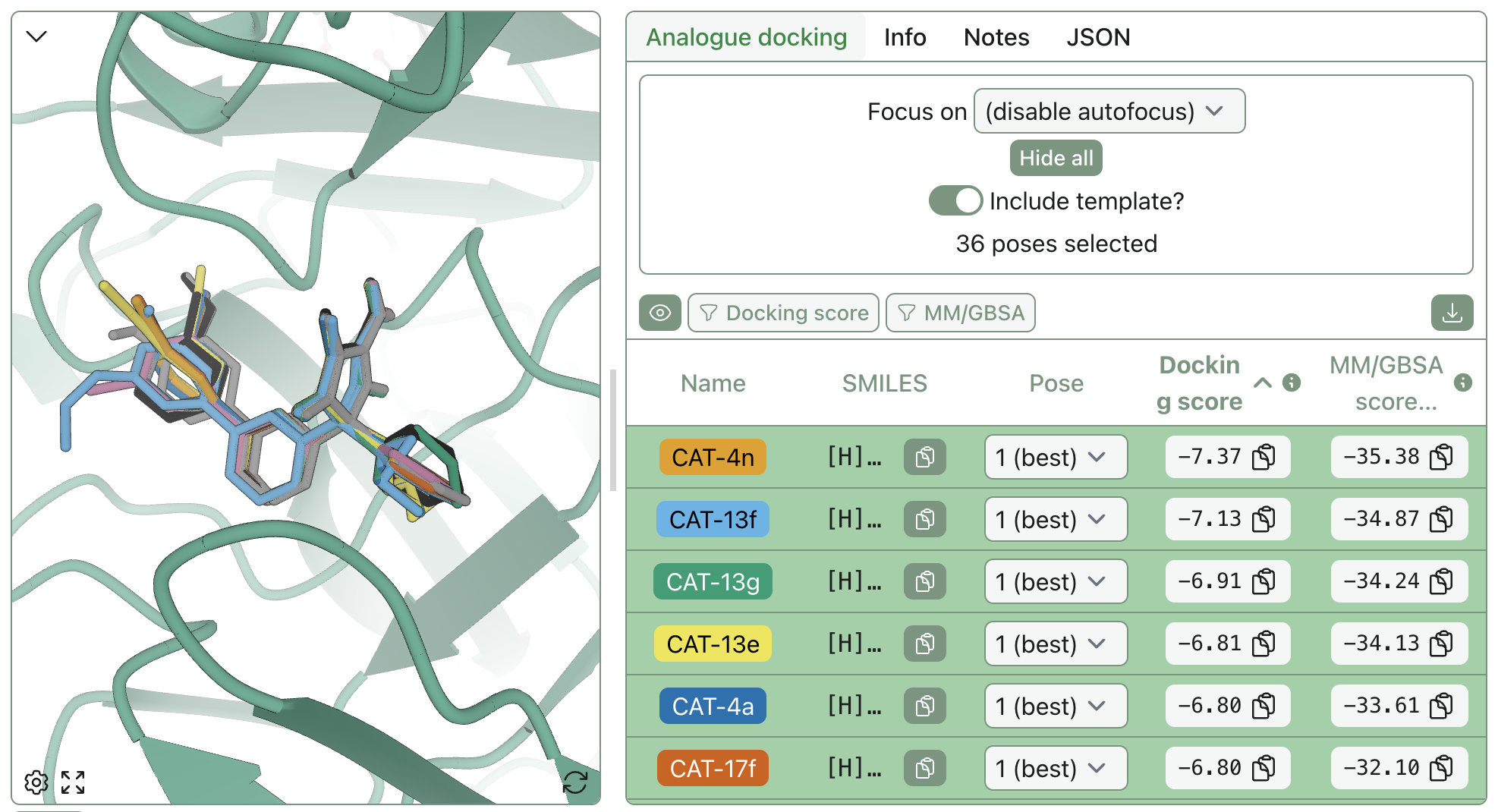
Figure 4. Overlay of the best Vina-ranked pose for each BACE analogue after MM/GBSA optimization.
That said, the effect varies quite a bit by system. For some targets, optimization barely changes the poses, while for others the shifts are more noticeable. In many cases, the optimization seems to make relatively local adjustments: the shared core may move slightly, while flexible side groups relax into better geometries. Those changes can offset one another and sometimes even bring the overall pose closer to the JACS reference.
There are also a small number of clear outliers. When a starting pose clashes with the protein, optimization can move the ligand much more substantially. These larger changes are concentrated in a few systems, particularly MCL1 and PTP1B. The optimization may be correcting an unrealistic clash, but it can also shift the shared core and leave the final pose less well-aligned with the JACS reference. Reducing these outlier cases is an area for future development.
Does any of this matter for RBFE?
Pose RMSD is useful, but analogue docking is not usually the final goal. One of the main reasons we care about analogue docking is to generate consistent starting structures for downstream RBFE calculations.
So we then tested (although in a limited fashion) whether picking the absolute lowest RMSD pose to the reference structure actually improves RBFE. To do this, we took the JNK1 set and ran the downstream RBFE workflow using several different ways of choosing the starting pose: the top-ranked Vina pose before MM/GBSA optimization, the top-ranked Vina pose after MM/GBSA optimization, the top-ranked optimized pose by MM/GBSA score, and the lowest-RMSD pose to the JACS reference structure from both the unoptimized and optimized pose sets. The resulting RBFE performance, comparing experimental and mean-corrected calculated values, is shown below:
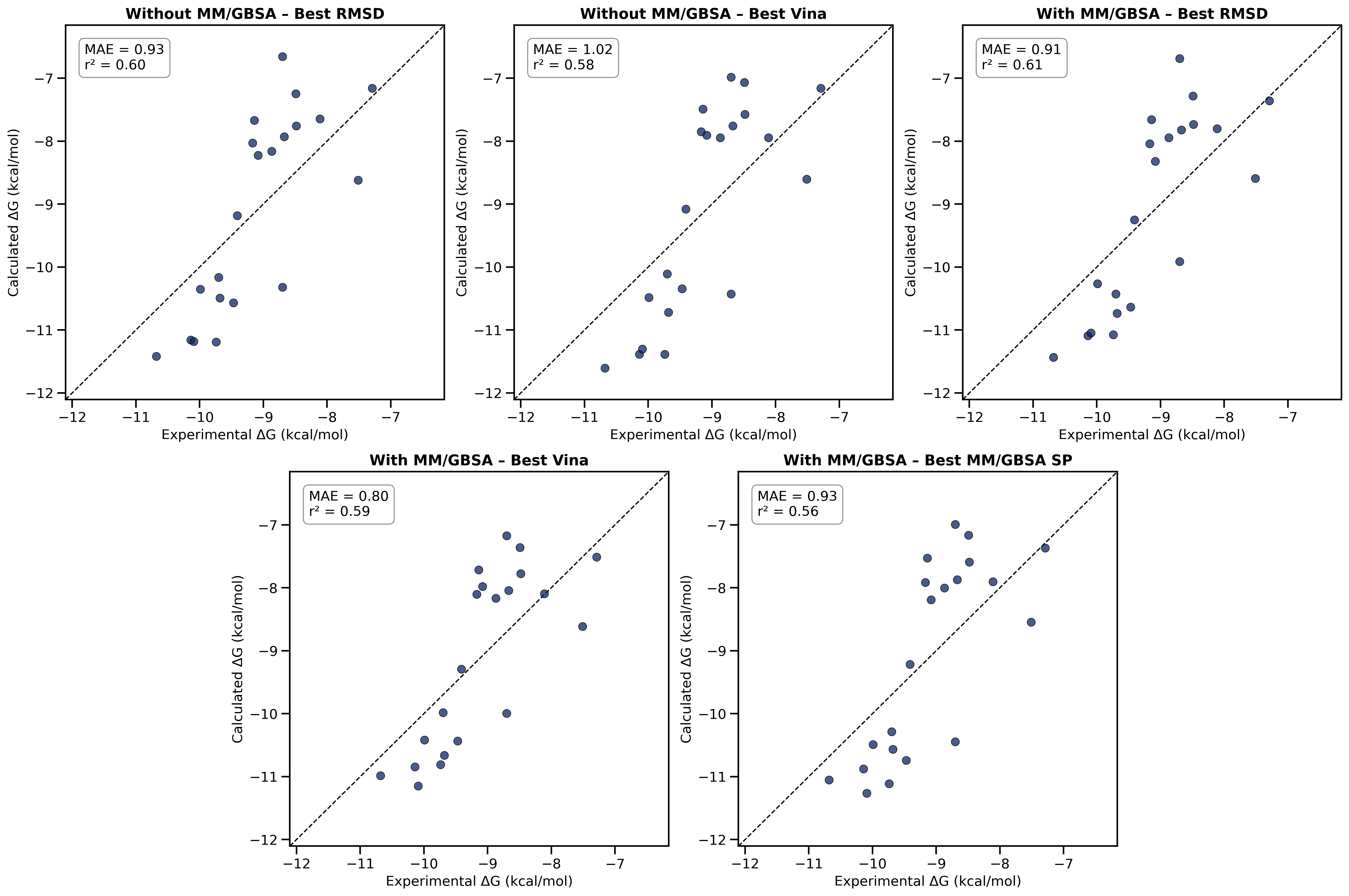
Figure 5. Mean-corrected calculated versus experimental JNK1 binding free energies using five pose-selection strategies.
The differences were very small. Across the five pose-selection strategies, the r² against experimental values ranged from about 0.56 to 0.61, with the highest r² coming from the optimized, lowest-RMSD poses. The mean absolute error (MAE) ranged from about 0.80 to 1.02 kcal/mol, with the lowest error actually coming from the poses selected by Vina after MM/GBSA optimization. In other words, using the generated pose closest to the JACS reference pose did not provide a noticeable advantage over using the pose selected by the workflow. Of note, in our previous update, we ran the RBFE benchmark for JNK1 on the set of JACS reference structures, and this also provided comparable results to our new pose sets.
That does not mean RBFE can rescue any analogue-docking failure. JNK1 is a relatively clean system, and none of the poses selected by Vina or MM/GBSA had more than 2 Å RMSD from the JACS reference pose—so we do not want to draw broad conclusions from this single example. But these data do show that Rowan's analogue-docking workflow can provide useful starting poses for well-behaved downstream RBFE calculations, even when the top-ranked pose is not the absolute lowest RMSD pose in the ensemble.
In conclusion, the default pose-ranking approach is not perfect, but it is surprisingly difficult to improve upon. More complicated rescoring methods did not consistently increase our chances of selecting the single lowest-RMSD pose, and at least for JNK1, the remaining differences between reasonable poses did not meaningfully affect downstream RBFE performance. The RBFE comparison is still an N=1 result, so the obvious next step is to repeat this analysis across more systems. But for now, these results are encouraging.
We believe that our current pose-selection approach is good enough for many real-world RBFE scenarios, enabling end-to-end FEP workflows to run entirely in code without notable human intervention. We're excited to continue working toward making efficient and cost-effective FEP possible at scale.