What We Learned from Our User Survey
by Ari Wagen and Corin Wagen · Aug 31, 2026

Since we started Rowan three years ago, we've always loved getting feedback from users; early on, our founding team would throw around the YC adage "build something people want." As we scale, it can be harder to get a pulse on what people want, so we decided to ask!
We opened a 30-question survey for two weeks and linked to it in our app & from our newsletter. We heard back from lots of people. Here are some of the things they said:
If a friend asked you what Rowan did, what would you say?
There were a lot of great answers to this question, so we made a little Mad Libs–style component to share the responses (click on a phrase to change it, or regenerate the entire list):
- Rowan is ...
- Rowan is ...
- Rowan is ...
Rowan grows within communities
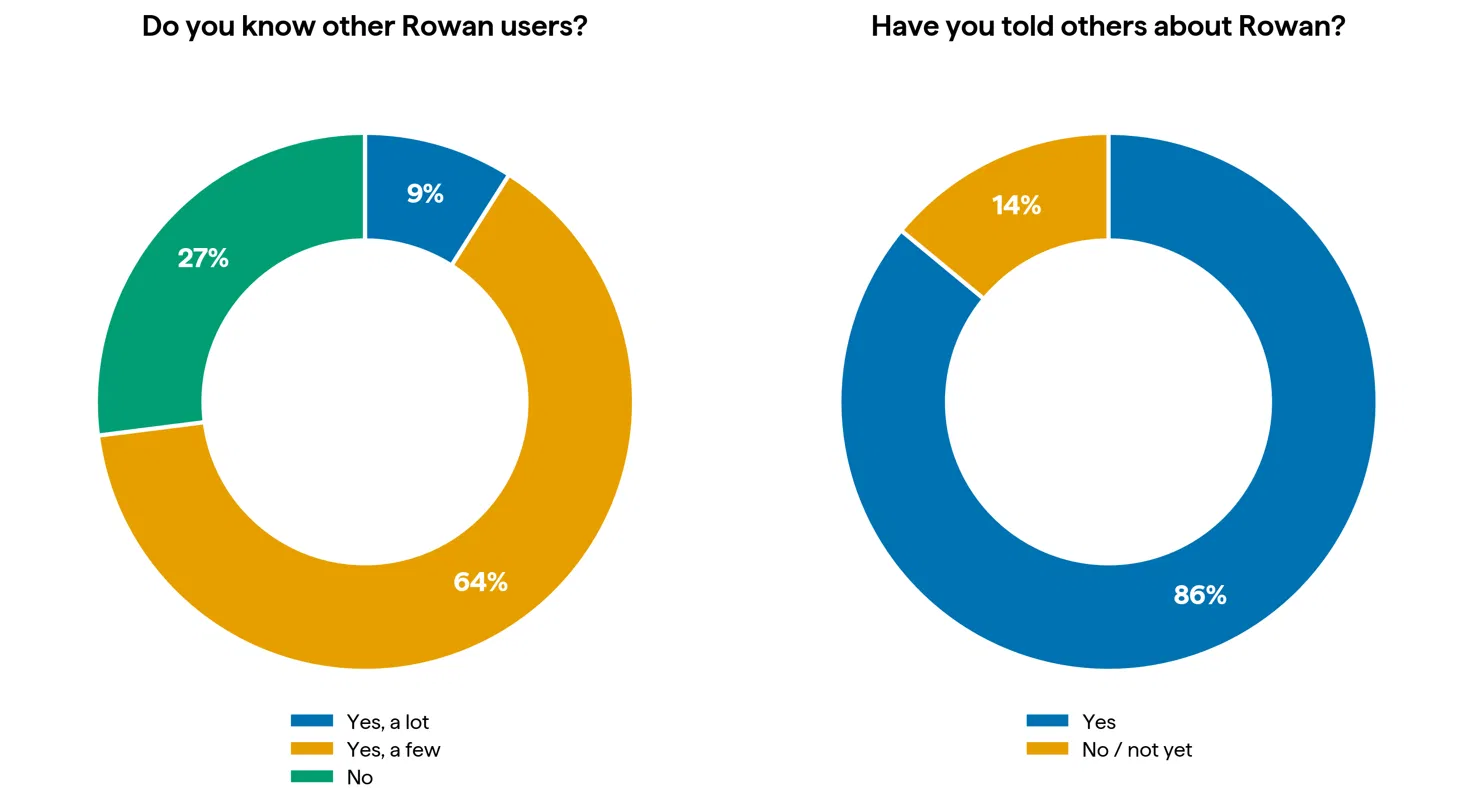
A vast majority of Rowan users (73%) know other people using Rowan, and almost everyone using Rowan has brought it up with others (85%), whether in a group meeting, at a conference, or with co-workers.
Users come for a tool and stay for the platform
Most people heard about Rowan from word-of-mouth channels or when searching for a tool with a specific capability, but after they started using Rowan, they tried other capabilities of the platform. Some of the most common features they were looking for:
- Specific molecular modeling methods like DFT, xTB and g-xTB, and machine-learned interatomic potentials like UMA.
- Small-molecule conformer searching.
- Property prediction, whether pKa, solubility, logP, or something else.
- Structure-based tooling like docking and co-folding.
- NMR spectra prediction.
When users first created accounts, many found Rowan easy-to-use (82%):
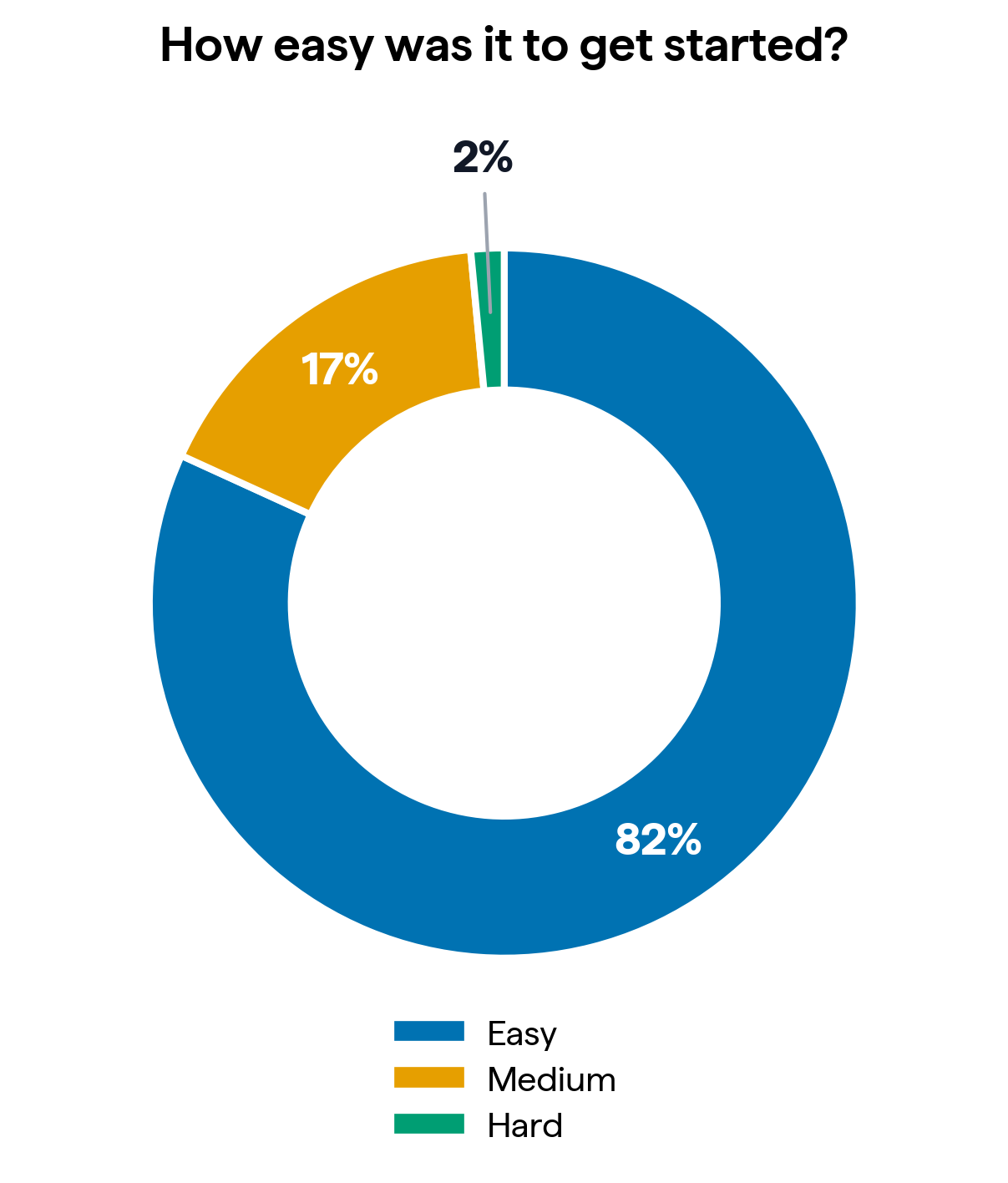
Users specifically mentioned Rowan's graphical user interface, ability to import compounds directly from SMILES or PubChem, and structure editor as easy to use. Users also found it easy to run many of our workflows including optimizations, scans, conformer searches, pKa and redox potential predictions, docking, co-folding, and ADME-Tox predictions.
On the flip side, some of Rowan's features are harder to use—we'll highlight these below, and we're working to address these concerns (part of why we do user surveys!).
Most users use the GUI, but agent integrations are growing
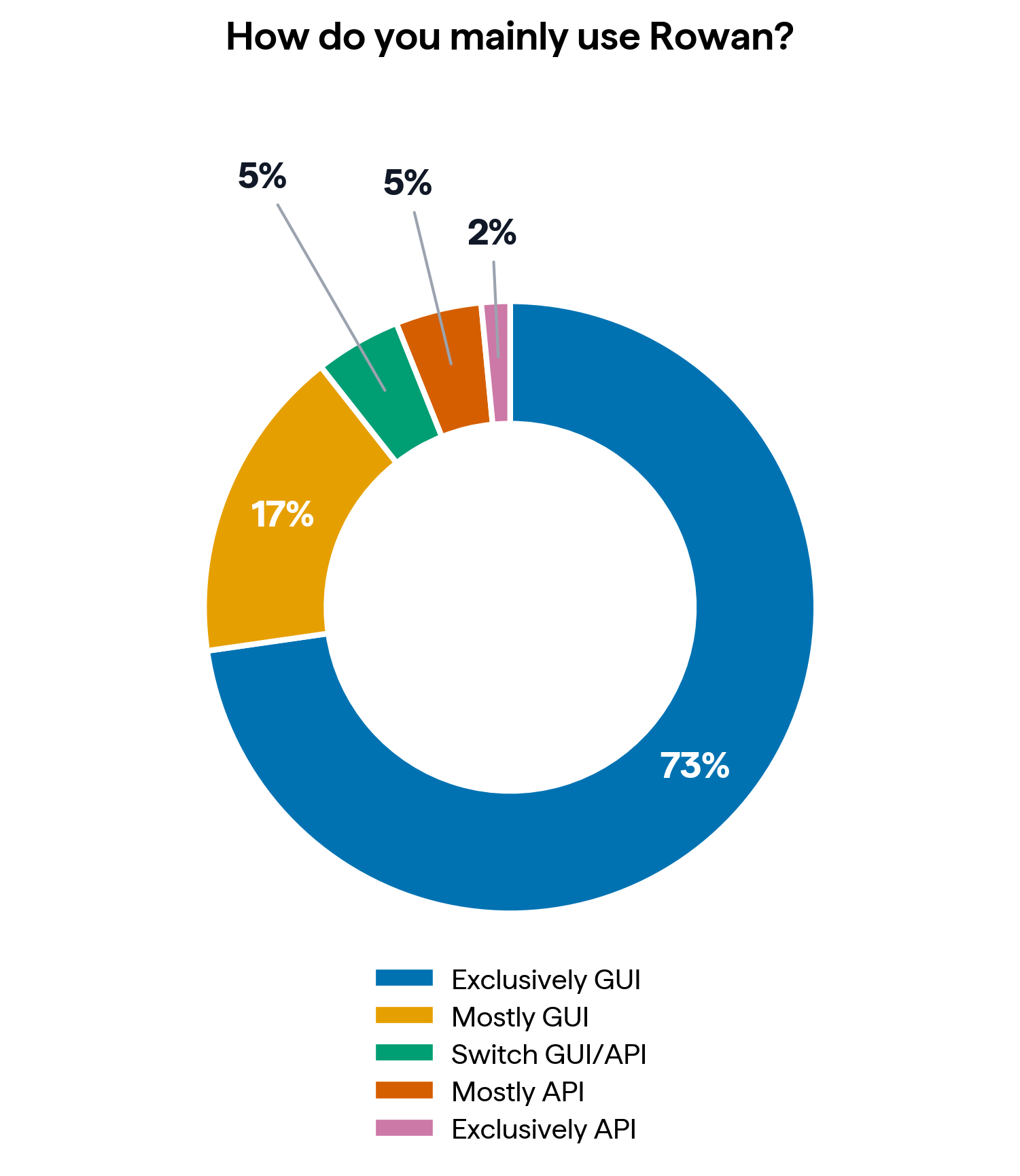
Most people use Rowan exclusively through the GUI (73%) as opposed to through our Python API; this result didn't surprise us. We've noticed that even when users do start using the API for high-throughput modeling, they continue to use the GUI for its convenience.
In a separate question, we asked about how users integrated Rowan with other software. A majority of Rowan users (66%) use Rowan as a completely standalone tool. The remaining third paired Rowan with on-premise DFT, standalone visualization softwares, and, increasingly, agentic systems like Claude Science. Anecdotally, we've been surprised by the rate of agent adoption even inside biopharma companies—industry often has a reputation for being stuffy or slow to adopt new software, but we haven't found this to be true.
We've lowered the barrier, but specialist tools can still be overwhelming
Despite many users highlighting Rowan's ease of use, accessibility, and clean interface, a number of users highlighted remaining points of confusion. Specifically:
- It can be hard to choose between conformer-search engines.
- Advanced settings overwhelm new users.
- There's a lot of expertise that has to be learned by reading, even if we have good documentation.
- The breadth of the Rowan platform can be intimidating.
Some of this can be addressed by our team—better conformer-search engines avoid narrow tradeoffs, making it easier to choose the "right" option without extensive expertise. (This is part of why we've been working on openconf.)
There's more work to do
There were lots of places to give feedback throughout the survey; users highlighted a few recurring trends:
- Tools for designing covalent inhibitors lag those for designing non-covalent inhibitors. It's hard to set up covalent docking and co-folding runs, and molecular dynamics with covalently bound ligands remains wholly the realm of expert users.
- When making big changes in ligand size or when you don't have a great holo protein, Rowan needs something like induced-fit or flexible protein docking. (We're working on this!)
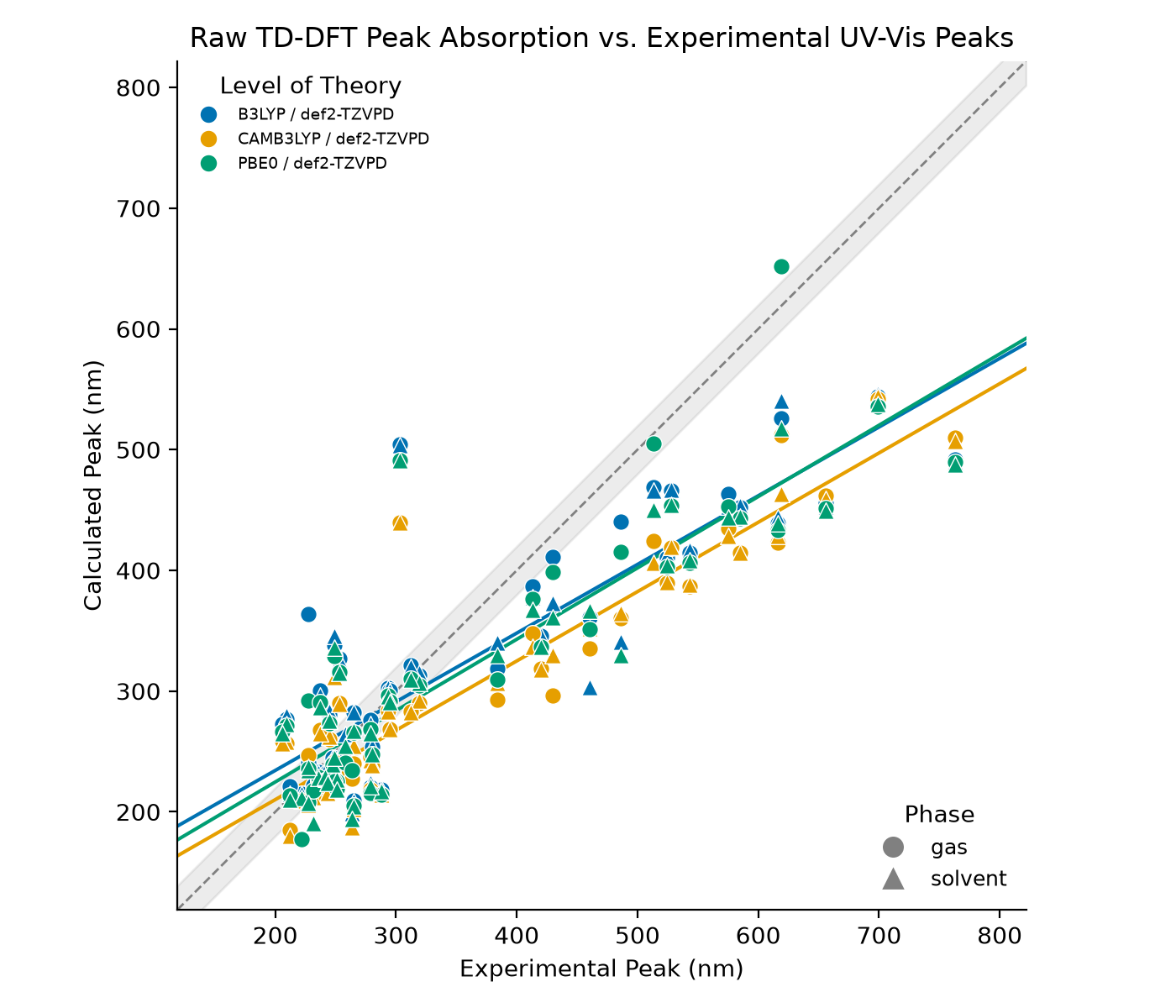
- There's a lot of analytical chemistry tooling to be built; though we support IR, CCS, NMR, and now UV-Vis prediction, users brought up a desire for additional tooling for spectrometry and chromatography (Raman, NOE, EPR, TLC, LC-MS, GC-MS).
We're excited to continue improving and building tools to make computation accessible and useful for chemical scientists, and we're grateful to our users for the excellent feedback.
If you haven't tried Rowan yet, now could be your time: try out one tool, stay for the platform, integrate Rowan with your agent, and tell your friends!
Qualifications
These results are skewed by survivorship bias: all of these statistics are from people who like Rowan enough to fill out a survey for free Rowan credits.







.jpg)